
We Read 79 Website RFPs. Here's What They Ask For
Our study of 79 public website redesign RFPs from 2024 to 2026: how often they state a budget, how little price counts in the score, and how few say what the new site has to achieve.
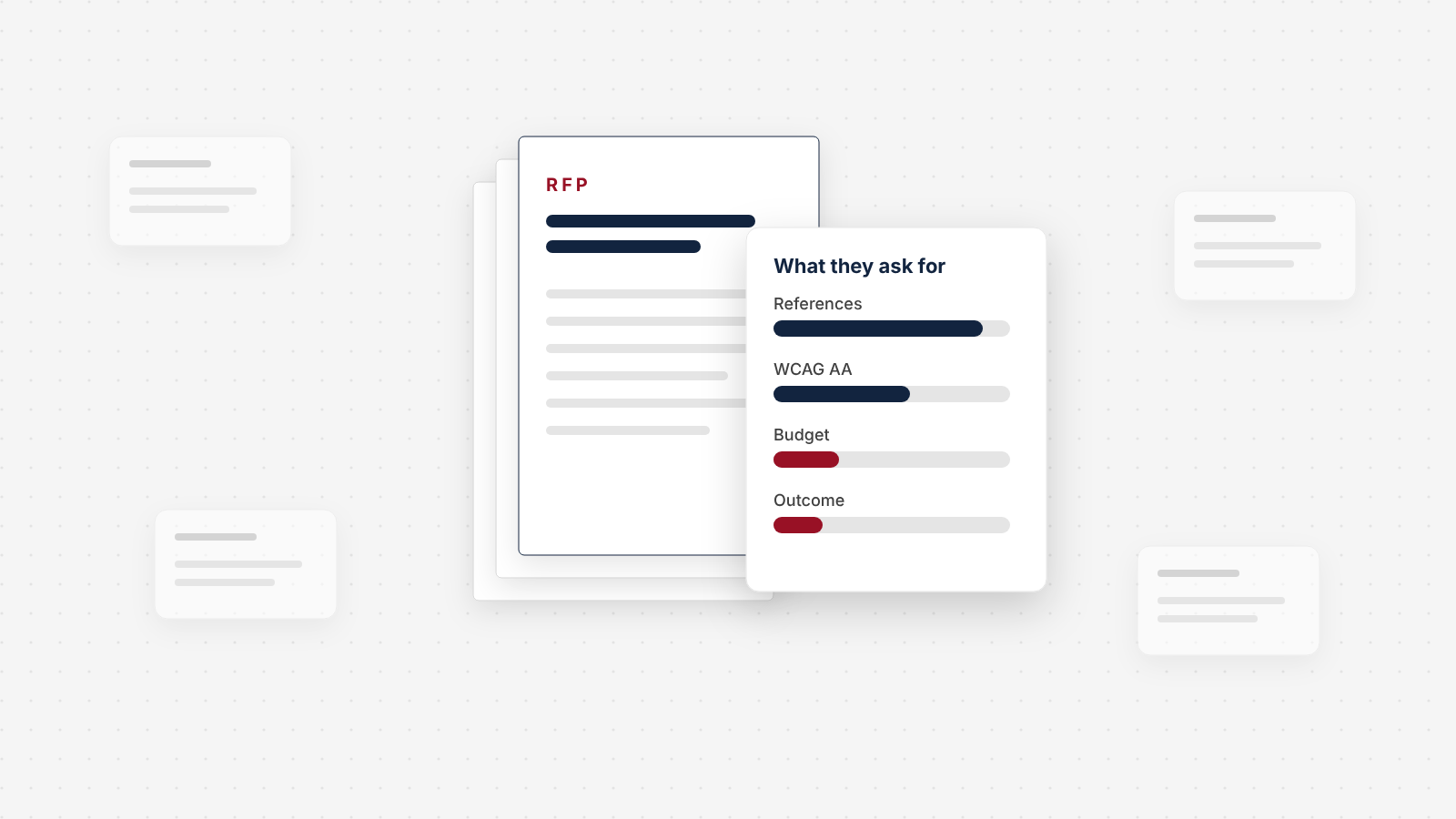
We read 79 public website redesign RFPs issued in the US over the last two years. About 1 in 5 asks the new site to achieve anything you could measure, and just one sets a numeric target. Only 1 in 4 says what the buyer plans to spend. And in the RFPs that publish how they score proposals, price is worth a median 15% of the decision. Most of these documents treat launch day as the finish line, then pick an agency on experience, approach and references.
If you're about to write an RFP for your own website, this is a useful look at how other buyers do it, and at the gaps that keep showing up. We've also turned the findings into a short list of what to put in yours.
What we looked at
We collected 99 US RFPs for a website redesign or website design that were issued between October 2024 and October 2026, from public procurement portals and RFP posting sites. We read 79 of them in full, and every share in this article uses those 79.
Who issued the 79 RFPs we read in full
We didn't find a single RFP from a private company. That's not a surprise: governments and many nonprofits have to post their RFPs publicly, and private firms almost never do. So this study describes public and nonprofit buyers, and we'll say so again wherever it matters.
If you run a $10M manufacturer, you might wonder what a county's RFP has to do with you. Two things. First, these are the only formal website RFPs anyone can read in bulk, so they're the best evidence there is of what a typical RFP asks for and what it leaves out. Second, the agencies answering them are often the same ones you'd invite. When your RFP lands, they read it next to documents like these, and the gaps below are where yours can stand out.
Three in four RFPs don't say what they'll spend
Only 20 of the 79 RFPs stated a budget. That's a lower bound, because some buyers gave a figure only when an agency asked during the question period, and we only counted what we could find in the documents.
Where there was a one-off budget, the median was about $45,000, and the middle half of budgets ran from roughly $25,000 to $80,000. Government RFPs came in lower, at a median of $37,500, and nonprofits and associations higher, at $55,000. Each of those two medians rests on just 9 RFPs, so read them as rough guides.
Leaving the budget out doesn't get you a better price. It means every agency guesses at the size of the job, and you get back proposals for very different projects that you can't compare. For a sense of what B2B redesigns cost outside the public sector, our guide to what a B2B website redesign costs walks through the numbers and what moves them.
Price is a small part of the score
Nearly half the RFPs (38 of 79) published the weights they'd use to score proposals. That's one of the more useful things about public procurement: you can see exactly how the decision gets made.
Most of the score went to the agency's experience, its approach and its references. Two rubrics gave cost no points at all.
This matters if you're writing an RFP, and it matters if you're an agency deciding whether to bid. With price worth around 15%, a low bid rarely wins on its own. An agency that undercuts everyone by a third and writes a thin proposal will usually lose to one that costs more and shows it understood the problem. For a buyer, it's a reminder that the most useful thing in a proposal is the thinking, and the RFP should ask for the thinking it wants to see.
Most RFPs define success as launch day
This was the gap we expected, and it was wider than we thought. We looked for any sign that the buyer wanted the new site to move a number: more inquiries, more applications, more donations, more traffic to a key page.
How the 79 RFPs define what the new site should achieve
About 19% of the RFPs (15 of 79) asked for any measurable outcome at all. Only 6 told agencies where the numbers stand today, and only 1 set a target. Another 30 asked for analytics to be set up and stopped there, which is a bit like installing a scale and never deciding what you'd like it to read.
When an RFP doesn't say what the site has to do, agencies answer the question it does ask: pages, features, a timeline. Everyone promises a launch date, and nobody is on the hook for what happens after it. This is the gap our website redesign RFP template is built to close, with a required section for the baseline, the target, and what the agency commits to if it misses.
Half of RFPs require WCAG Level AA
For many of these buyers, accessibility is written into the requirements. 61% of the RFPs name WCAG, the Web Content Accessibility Guidelines, and 51% require conformance at Level AA.
Which WCAG AA version the RFPs require
Most of the RFPs that pick a version still ask for 2.1. Only 7 ask for 2.2, the current version, which adds a handful of criteria on things like focus visibility and target sizes. Government buyers are more likely to name WCAG than nonprofits, at roughly 7 in 10 against roughly 4 in 10.
For a private B2B company, the same logic applies. If you sell to government, to large enterprises, or to anyone with a procurement team, many of your buyers will expect an accessible site. Naming WCAG 2.2 AA in your RFP costs you nothing to write, and it tells every agency you'll check.
Expect a month to respond and a crowd of bidders
Here's what the process looked like across the sample:
- The median response window was 28 days.
- 81% required references.
- 72% held a formal question and answer period.
- Buyers expected launch about 6 months after the contract was awarded (the median across the 27 RFPs that gave dates).
Where we could find award records, public RFPs drew between 17 and 47 bidders. Public RFPs are open to anyone, so the numbers run high. A private company can invite three to five agencies instead, which is what we recommend in our RFP guide.
The bidder counts also explain a lot about how agencies behave. When an agency sees an RFP with no budget, no target and dozens of likely competitors, the sensible move is a fast, templated response or no response at all. A clear RFP, with a budget range, a measurable goal and a short list of invited agencies, is the kind good agencies make time for.
What to put in your RFP
Here's what we'd take from all this if we were writing a website RFP for a $2M to $20M B2B company. Our free website redesign RFP template has a place for each of these.
- Put a budget range in. Three in four RFPs leave it out, and that's the main reason proposals come back impossible to compare. Give a range you'd sign. If you're not sure what's realistic, our redesign cost guide can help you set one.
- Write down today's numbers. Only 6 of 79 RFPs gave a baseline. Count your website inquiries and quote requests per month for the last 12 months. If tracking was never set up, write "unknown." That's an honest answer, and it tells agencies measurement comes first.
- Set a target, or ask agencies to propose one. Only one RFP in our study did this. Say what number you want, the window (for example 90 days after launch), and how it will be measured.
- Ask what the agency commits to if it misses. This is the question that separates agencies willing to be measured from the rest. Our template gives examples of acceptable answers.
- Name WCAG 2.2 AA. It's the current version, and only 7 of the RFPs we read asked for it.
- Publish your scoring weights. Fewer than half of the public RFPs we read did. Weighting price at 15% to 20% matches what public buyers do, and it tells agencies you'll choose on substance.
- Give agencies about four weeks, and a question period. That's the norm in our sample. Share every answer with every agency.
- Plan for about six months from award to launch, unless an agency's proposal makes a good case for faster. That's the median public buyers in our sample planned for.
If you've been putting off the RFP because it feels like a lot of paperwork for a website, that's fair. Most of the list above is one afternoon with your CRM and your analytics, and it does more for the quality of the proposals than another ten pages of requirements would.
How we did this
Sources. We searched public procurement portals and RFP posting sites for US requests for proposals covering a website redesign or website design. The data was collected on October 14, 2026.
Window. RFPs issued from October 2024 to October 2026.
Counts. We found 99 RFPs that matched and read 79 of them in full. All percentages and shares use those 79: 46 government, 24 nonprofit or association, 5 education and 4 tribal.
Coding. One researcher read each RFP and recorded whether it stated a budget, named WCAG and which level and version, published scoring weights and what price was worth, asked for measurable outcomes, a baseline or a target, required references, held a formal question period, and gave a response window and launch date. To check the coding, we went back to the source documents for 40 rows and checked them by hand.
What we counted as an outcome. Any request that the new site improve something measurable. Asking only for analytics to be installed didn't count.
Limits. Please read the numbers with these in mind:
- The study covers public and nonprofit buyers only. We found no private-company RFPs.
- Budget medians rest on small samples, 9 RFPs each for government and for nonprofits and associations. The budget share is a lower bound, since some budgets appear only in Q&A answers we couldn't always find.
- Launch timing comes from the 27 RFPs that gave dates, and bidder counts from the award records we could find, which covered only some RFPs.
- Coding was done by one person. The 40-row hand check catches mistakes in reading, but a second independent coder would make it stronger.
Questions about the study
What budget do public website redesign RFPs state?
Only 20 of the 79 RFPs we read in full stated a budget, about 1 in 4. Among those with a one-off budget, the median was about $45,000, and the middle half ran from roughly $25,000 to $80,000. Government RFPs had a median of $37,500 and nonprofits and associations $55,000, but each of those is based on only 9 RFPs, so treat them as rough.
How much does price count when a website RFP is scored?
Less than most people expect. Of the 79 RFPs, 38 published their scoring weights. At the median, price was worth 15% of the score, with a mean of about 19%. Two rubrics gave cost no points at all. Most of the score went to experience, approach and references.
Do website RFPs require WCAG accessibility?
Most name it. 61% of the RFPs we read name WCAG, and 51% require Level AA. WCAG 2.1 AA was the most common (31 RFPs), followed by 2.2 AA (7) and 2.0 AA (2). Government RFPs named WCAG more often than nonprofit ones, roughly 7 in 10 against 4 in 10.
Does this study apply to private B2B companies?
Indirectly. Every RFP we found came from a public or nonprofit buyer, because private companies rarely publish theirs. What carries over is the pattern of what formal RFPs leave out, and the fact that agencies read your RFP alongside these. A private buyer who states a budget and a measurable target is writing a clearer RFP than almost all of the ones we read.
How long do agencies get to respond to a website RFP?
The median response window in our sample was 28 days. 72% of the RFPs held a formal question period and 81% required references. Buyers expected launch about 6 months after the contract was awarded, going by the 27 RFPs that gave dates.
Keep reading
 UX & Web Design
We Audited the Quote Request Path on 150 Manufacturer Websites
We checked how 150 US manufacturers handle the moment a buyer wants a quote: the form, the file upload, the reply promise, the specs and proof around it, and the email behind it. About half have a dedicated quote form. Only 7% say when they'll reply. Here's what we found, sector by sector, and a 10-point check for your own site.
 UX & Web Design
How to Create an Autism-Friendly Website: 5 Mistakes to Avoid and How to Test
An autism-friendly website is calm, predictable, and literal. That also describes a site a busy B2B buyer can use in two minutes. Here are five common mistakes, how to fix them, and how to test your site.
 UX & Web Design
Website Care Plan Prices in 2026: What 72 US Providers Charge
We read the published pricing of 72 US website care providers and logged all 187 plan tiers. The median entry plan is $99 a month. Here's what that buys, what the top tiers add, how few providers test updates or promise a person at night, and the questions to ask before you sign.
See exactly where your site is losing conversions
Paste your URL and get an instant conversion score. No form to fill out, no sales call.
Strategies for businesses building what's next.
The Next Draft: occasional notes on turning B2B websites into pipeline. Unsubscribe any time.