
Food and Beverage Manufacturer Websites: What Buyers Check Before They Call
Most food website advice is written for consumer brands. This is the supplier side: what a brand's quality, procurement and R&D people check on a co-packer, ingredient supplier or private label site, and the pages, documents and certification details that keep you on their list.
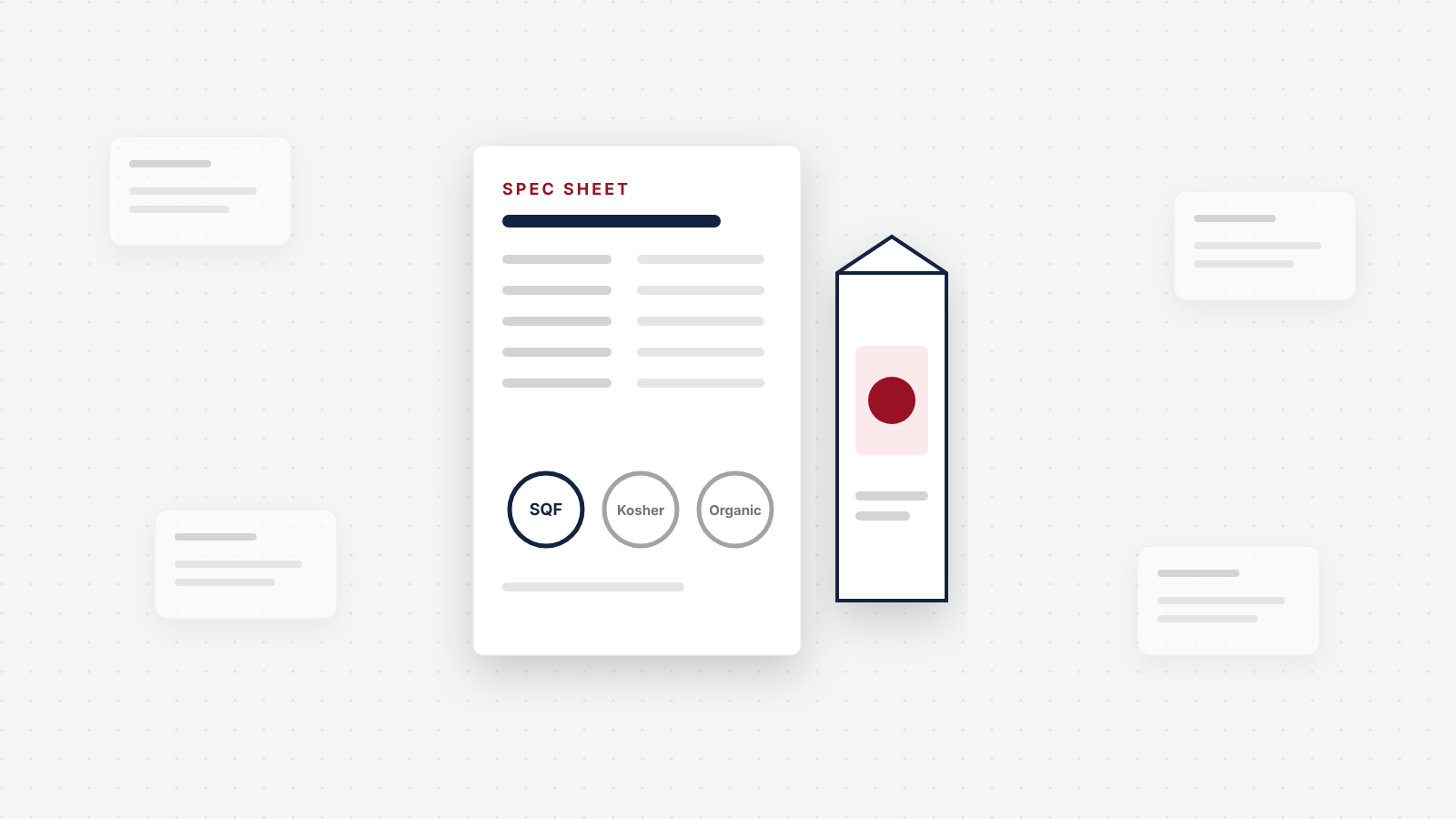
Most advice about food and beverage websites is written for consumer brands: appetizing photography, recipes, the founder's kitchen story. That is not who decides whether a co-packer, an ingredient supplier or a private label plant gets the business. The people deciding are a quality manager with a supplier approval checklist, a procurement lead comparing minimums and lead times, and a product developer who needs a spec sheet today. To them, your website is the first page of a supplier approval file. Build it like one, and put the documents ahead of the photos.
What buyers check on a food manufacturer's website
Before a brand calls you, someone on their side checks seven things on your site, roughly in this order. Check your own site against them now:
The seven-point buyer check
Look at your site the way a brand's QA or R&D lead would, and answer yes or no. Tap a name to jump to how to fix it.
0 of 7 answered
0 yes0 no
- What you make, and in what formats
Does your site list product types, pack formats, fill sizes, and whether you run ambient, refrigerated or frozen?
- Your food safety certification
Does it show which scheme, which scope, which certification body, and that the certificate is current?
- Other certifications and claims
Are organic, kosher, gluten-free, halal and similar claims listed, each with its certifier?
- Allergen and facility profile
Does it say which major allergens are in the building, and which lines they run on?
- The documents
Can a buyer open spec sheets and allergen statements, and see a clear list of what else you send?
- Commercial fit
Does it give minimum order quantities, lead times, capacity, and what development or storage costs?
- A way to start
Is there a project or RFQ form that asks the right questions, and a named person in sales and in quality?
Your answers stay in this browser only.
Fail one and you rarely hear about it. A quality manager does not write to say your certificate on the site expired in March. They move to the next supplier on the list.
The same pattern holds across manufacturing. We wrote up the general version, for machine shops and industrial suppliers, in what manufacturing buyers check before they send an RFQ. Food adds three things that general guide only touches: a regulated supplier approval process on the buyer's side, a much denser certification landscape, and allergens.
Four businesses, four different first questions
"Food manufacturer" covers businesses that sell to very different people. Most of the agency advice we read on this topic blends them together, and blends in consumer brands too. Start by deciding which of these you are, because it changes what goes at the top of every page.
| Your business | Who checks your site first | What they need to see first |
|---|---|---|
| Co-packer or contract manufacturer | A brand's founder or operations lead, then the brand's QA | Formats and pack sizes you can run, minimums, lead times, certification, allergens on site |
| Ingredient supplier | A product developer in R&D, then QA and procurement | Spec sheets, allergen and origin information, certifications, how you handle certificates of analysis |
| Private label manufacturer | A retailer's private brand team and its QA | The categories you make, certification against the retailer's supplier standards, capacity, packaging capability |
| Branded CPG selling to retail, distributors and foodservice | A category buyer, a distributor, a foodservice operator | Item data (UPC, case pack, pallet), pricing structure, a sell sheet, how to get samples |
Many plants are two of these at once, for example a co-packer that also sells its own brand. That is fine. Give each audience its own path from the homepage, so a QA manager never has to scroll past retail sell sheets to find your certificate.
Your website is the first page of a supplier approval file
Here is why food is different from most B2B buying. In the United States, a large share of supplier vetting is not a preference. It is written into federal rules.
Under FDA's Preventive Controls for Human Food rule, a manufacturer that relies on a supplier to control a hazard in an ingredient must run a supply-chain program. It has to approve that supplier, and document the approval, before it receives the ingredient. It then verifies the supplier with one or more of four kinds of activity: onsite audits, sampling and testing, a review of the supplier's food safety records, or other activities suited to the risk. Where the hazard could cause serious illness or death, the default is an onsite audit before first use and at least once a year after (21 CFR 117, Subpart G).
Two details in that rule matter for your website. First, it applies when a hazard is controlled in the supply chain, not to every purchase, so do not tell buyers they are "required" to approve you in a particular way. Second, the buyer cannot accept your own audit of yourself as verification, although an audit by a qualified third-party auditor can count (21 CFR 117.415). That is one reason third-party certification matters so much in this industry, and why buyers look for the certificate, not a paragraph about your commitment to quality.
Buyers then ask for a stack of documents. Two published examples show the shape of it:
- Markon, a foodservice produce buyer in Salinas, California, publishes its supplier document matrix. It asks suppliers for a certificate of insurance, a third-party facility audit report with its certificate and corrective actions for each location, a letter of guarantee, a traceability program, a supplier approval program, and, where they apply, an allergen statement, a kosher certificate and an organic certificate (Markon, Supplier Document Requirements).
- Manitoba's provincial food safety guidance tells processors that supplier programs commonly require a current letter of continuing guarantee, updated yearly, a certificate of analysis with each lot, a third-party certification report, and a signed supplier questionnaire (Government of Manitoba, Supplier Management).
None of that paperwork happens on your website, and nothing on your website counts as verification. What the site can do is answer the screening questions before the paperwork starts, so the QA manager opens your approval file already expecting to approve it.
Your website will never be the approval. It can be the reason you reach the approval stage.
Traceability is also tightening. FDA's Food Traceability Rule will require companies that handle foods on its Food Traceability List to keep specific records and hand FDA a sortable spreadsheet within 24 hours of a request. FDA has said it will not enforce the rule before July 20, 2028, following a directive from Congress (FDA, Food Traceability Rule). If you handle listed foods, a short, accurate paragraph on how you trace lots tells a buyer you are already ahead of it. If you do not, leave it out rather than borrow the language.
Brands are shopping for equipment and formats
The demand side is growing. In PMMI's 2024 report on contract packaging and contract manufacturing, 67% of brand owners said they plan to maintain or increase their use of contract packagers and manufacturers (PMMI, 2024).
The more useful number is why they outsource. The top reason is not cost or capacity. It is access to machinery and packaging formats the brand does not have:
Why brand owners use contract packagers and manufacturers
A food industry vendor survey points the same way: in TraceGains' 2023 report, 55% of nearly 300 food and beverage professionals said they outsource more manufacturing than they did three years before (TraceGains, 2023). That is vendor research, so treat it as directional.
Read the chart as a page brief. If most brands come to a co-packer for equipment and formats, then "what can you run" is the headline of your site, not "quality you can taste." The brand is looking for the line that can fill its stand-up pouch, its 12-ounce can or its single-serve cup, at its volume. Make that the first thing they find.
Build it page by page
These are the pages that carry the weight on a food or beverage manufacturer's site, in the order a buyer tends to reach them. Not every plant needs all eight. A pure ingredient supplier can skip the trade page; a co-packer with no retail brand can skip it too.
The formats page: say exactly what you can run
This is the page most food manufacturer sites get wrong. It usually reads "Full-service co-manufacturing for sauces, snacks and beverages" above a photo of a filling line, with nothing a brand could plan against.
How to do it
- Give each product category or format its own page or section: liquids and sauces, dry blends, bars, beverages, frozen, and so on.
- On each, list the pack formats (pouch, jar, can, bottle, stick pack, bulk tote), the fill sizes or weight range, and the temperature state (ambient, refrigerated, frozen).
- Add the processes that matter for that category, such as hot fill, retort, high pressure processing or aseptic, only if you run them in house. If a partner does it, say so.
- Add your typical run sizes as a range, and the number of lines for that format.
See a worked example
This is an illustrative example, not a client. A sauce co-packer's page might read: "Hot-fill sauces, dressings and marinades. Glass jars 8 to 32 oz, PET bottles 12 to 24 oz, 1-gallon foodservice jugs. Two hot-fill lines. Typical runs: 2,000 to 40,000 units. Ambient shelf-stable only." A brand founder can tell in ten seconds whether to keep reading. The brand that needs a refrigerated dip in tubs rules itself out, and your sales team never spends the call.
Steal our AI prompt
I run a food and beverage co-manufacturing plant. Below is the text of our current capabilities page and a list of our lines with what each one runs. Rewrite it as one section per product category. For each, give a heading a brand would search for, a one-line summary, and a short spec list: pack formats, fill sizes, temperature state, in-house processes, number of lines and typical run sizes. Mark anything you had to guess as [CONFIRM]. Current page: [paste]. Lines: [paste]
The certification hub: the scheme, the scope and a way to check it
A row of logos in the footer tells a QA manager almost nothing. They want the scheme and its exact name, the scope of products and processes, the certification body, the certificate number, the expiry date, and ideally a way to check it themselves. Most of the major schemes let them.
GFSI, the Global Food Safety Initiative, does not certify anyone. It benchmarks certification programmes, and its list of recognised certification programme owners includes SQF, BRCGS, FSSC 22000 and IFS among others. Name the scheme you hold, not just "GFSI certified."
| Scheme or claim | Who runs it | How a buyer can check it | What to put on your site |
|---|---|---|---|
| SQF Food Safety Code | SQFI | SQF Certified Site Directory, searchable by facility name or certificate number | Code and edition, scope, certification body, certificate number, expiry, the certificate PDF |
| BRCGS Global Standard Food Safety | BRCGS | The BRCGS Directory, which shows only currently certificated sites | Standard and issue, scope, grade, certification body, expiry, the certificate PDF |
| FSSC 22000 | Foundation FSSC | The FSSC public register | Version, scope, certification body, expiry |
| USDA Organic | USDA Agricultural Marketing Service, through accredited certifiers | The Organic Integrity Database, which shows status and certified scope | Your certifier, your scope (handling, for most processors), and the certificate |
| Kosher | Private certifying agencies, for example OU or OK | The agency's own listing; OU, for one, has a searchable page for its letters of certification | The agency, the products or lines covered, and the letter of certification |
| Gluten-free claim | FDA defines the claim; private programs certify | For FDA's rule, your testing records; for a certification, the certifier | Whether you make the claim under FDA's rule (unavoidable gluten below 20 ppm, 21 CFR 101.91) or hold a separate certification |
Two rules on logos are worth knowing, because most sites get them wrong in one direction or the other.
SQF. SQFI's Logo Rules of Use, Edition 10 list the company website among the permitted uses, along with brochures, ads, press releases and email signatures. The logo is for sites certified to the SQF Food Safety Code that have their certification body's permission, and the logo files come from the certification body. Sites or addresses not on the certificate cannot use it. And the logo, or any wording that implies food safety criteria have been met, is not permitted on product packaging. So yes on the website, never on the pack.
BRCGS. BRCGS's guide for certificated sites lists websites and social media among permitted uses, allows the logo on outer business-to-business packaging, and prohibits it on any direct consumer product packaging. A site with exclusions in its scope cannot use the logo, and a site that cancels or does not renew must remove it within seven working days (BRCGS, Guide for Certificated Sites, v2.0).
If you hold another scheme, read its own logo rules before you use its mark. Do not assume they match.
How to do it
- Build one certifications page. For each certificate, list the scheme and its exact name, scope, certification body, certificate number and expiry date, with the certificate as a PDF.
- Link each one to the scheme's own lookup where one exists, so the QA manager can check you without emailing you.
- Write the scheme and level in plain text on your formats pages too, not only in a logo image. "SQF certified, Food Safety Code" in text is something a search engine or an AI assistant can read. A badge is not.
- Set a calendar reminder 60 days before each expiry date to swap in the new certificate.
Tools to use
The SQF Certified Site Directory and the BRCGS Directory, to check your own listing the way a buyer will. If your listing and your website disagree, fix whichever is wrong before a buyer finds it.
One thing that does not belong on the certifications page is the FDA logo. FDA says its logo is for its own official use and not for private sector materials, that food facilities do not need a certificate of registration, and that it neither issues nor recognizes registration certificates sold by private businesses (FDA). "Our facility is registered with FDA" in plain text is fine if it is true. A badge that looks like an approval is not. And while you are on it: food facility registrations must be renewed every two years between October 1 and December 31, and this year's deadline is December 31, 2026 (FDA, September 2026).
The document library: open what helps, list what you send on request
The product developer wants a spec sheet. QA wants the allergen statement and the certificate. Procurement wants to know that the rest of the approval packet exists. A document library serves all three, as long as you decide in advance what is open and what is not.
Our position, and some marketers will disagree: spec sheets for your standard products and ingredients should be open, with no form. They are the first thing a developer asks for, and a form in front of them tells that person you care more about their email than their project. What should not be open is anything customer-specific, sensitive or covered by a confidentiality agreement.
| Open to anyone | Listed, sent on request | Never on the website |
|---|---|---|
| Spec sheets for standard products and ingredients | Full third-party audit report and corrective actions | Customer formulas and specifications |
| Allergen statements | Certificates of analysis for specific lots | Names of customers under NDA |
| Certificate PDFs | Letter of continuing guarantee | Audit findings in detail |
| Nutrition facts for your own branded items | Certificate of insurance | Anything a customer has not approved for release |
| A one-page facility overview | Recall plan summary and mock recall results, if you share them |
The middle column matters as much as the first. Listing what you can send, and how fast, tells QA your approval packet is ready. "Audit report, COAs, letter of guarantee and certificate of insurance available on request. We send most packets within two business days" answers a question before it is asked. Only publish the turnaround you actually keep.
How to do it
- List every document a new customer has asked you for in the last year. Sort each into the three columns above.
- Put a revision date and, where it applies, the product code on every open document.
- Open each PDF on a phone. Anything over a few megabytes or unreadable on a small screen gets rebuilt.
- Add one "Request our supplier approval packet" button that goes to a person in QA, not a general inbox.
Guides to use
Our docs guide on PDFs and documents on your site covers file size, naming and when to gate.
The allergen and facility page: be exact, not reassuring
Allergens are where vague marketing language turns into risk. A brand making a nut-free product needs to know whether tree nuts are in your building, on the same line, or nowhere near it. "We take allergens seriously" answers none of that.
FDA recognizes nine major food allergens: milk, eggs, fish, crustacean shellfish, tree nuts, peanuts, wheat, soybeans and sesame. Sesame became the ninth on January 1, 2023, under the FASTER Act (FDA, Food Allergies). If your allergen information predates 2023 and does not mention sesame, a QA reader will notice.
How to do it
- Publish a simple table: the nine major allergens down the side, and for each, "not in the facility," "in the facility, separate lines," or "on shared lines," per facility.
- Describe your controls in a sentence or two (scheduling, changeover cleaning, validation) without promising outcomes you cannot guarantee. "Allergen-free facility" is a claim. Only make it if it is literally true and you can document it.
- Add the facility basics a buyer asks about: square footage, temperature zones, storage capacity, and whether you hold organic, kosher or gluten-free programs at that site.
See a worked example
This is an illustrative example, not a client. A bar manufacturer's table might show: peanuts and tree nuts, "on shared lines, scheduled last with full washdown"; milk and soy, "in the facility"; sesame, "not in the facility"; fish and shellfish, "not in the facility." A brand making a peanut-free product can see in five seconds that this plant is not for them, and the plant's sales team does not spend two calls finding that out.
Commercial fit: publish the ranges brands ask about first
A guide on Oklahoma State University's Food and Agricultural Products Center (FAPC) blog, written by a food industry consultant, lists the questions a brand should ask a co-packer. They are practical: how much capacity for growth you have, what audits you have, the minimum order volume, the lead time for production orders, the R&D fees for development, the average number of production tests to launch a product, and what storage you offer and what it costs (Oklahoma State University FAPC, 2021).
Every one of those can be answered with a range on your site. Most food manufacturer sites answer none of them. The case for publishing is simple: a range lets the brand that is too small, too early or in too much of a hurry rule itself out, and lets the right-sized brand arrive already expecting your terms.
Fees deserve their own line. New Hope Network's list of red flags when vetting a contract manufacturer includes manufacturers who add charge after charge on top of their base rate; one adviser quoted there warns, "Watch out for anybody that fees you to death" (New Hope Network, 2019). You do not need to publish a price list. You do need to say which kinds of fees exist: development, line trials, storage, minimum run charges.
How to do it
- Write down, per format, your typical minimum run, your typical lead time for a repeat order and for a first run, and how many trial runs a launch usually takes.
- Publish them as ranges, with one honest sentence on what moves them (formula, packaging supply, season).
- List the kinds of fees you charge, even if you do not list the amounts.
See a worked example
This is an illustrative example, not a client. "Minimum run: 5,000 units per SKU for jars, 10,000 for pouches. Lead time: 4 to 6 weeks for repeat orders once packaging is on site; first runs typically 10 to 14 weeks including one or two trial runs. Development, trial run and storage fees apply and are quoted upfront." Every number there is a question someone on your team answers on the phone each week.
Proof without breaking confidentiality
Brands want to know you have made something like their product before. New Hope's advisers put it plainly: "Find out if a manufacturer has worked with brands like yours before" (New Hope Network, 2019). But co-packers and private label plants usually cannot name customers. That is normal in this industry, and buyers know it.
So describe the work without the names. Group it by category and format: "Organic nut butters in glass jars for natural channel brands, 2019 to now." "Private label granola for regional grocery chains, three retail programs." Add years in operation in that category, the number of SKUs you run, and the channels your customers sell into. Offer customer references on request, once there is mutual interest and the customer has agreed.
What you should not do is invent a case study or a testimonial to fill the page. A QA manager who asks to speak to that customer, and cannot, will remember.
The project form: ask what your team needs to quote
The last step is where a lot of food manufacturer sites lose the brand they just convinced. The form is a generic "Contact us" with a message box, or it asks twenty questions before saying anything about what happens next.
Ask for what your team needs to judge fit and start a quote, and nothing more. The fields that do the most work are in the template further down. Two lines matter beyond the fields: say who reads the form and how fast you reply, and say what you need before any formula changes hands. The OSU guidance advises brands to have a non-disclosure agreement in place before sharing a product spec or formulation, so say on the form that you will send one (Oklahoma State University FAPC, 2021).
How to do it
- Cut the required fields to the ones in the template below. Make everything else optional.
- Add a line above the button: who reads the request, how fast you reply, and that you send an NDA before formulas are shared.
- Submit a test request from a phone every month and check that it lands with a person.
- Watch real visitors use the form for a week with a free session recording tool such as Microsoft Clarity. Where they stop is where the form is broken.
Steal our AI prompt
We are a food and beverage manufacturer. Below are the fields on our current inquiry form and a short description of how our sales and R&D team decides whether a new project fits. Tell me which fields we need to judge fit and start a quote, which should be optional, and which to remove. Then write the short line above the submit button saying who reads the request, how fast we reply and that we send an NDA before formulas are shared. Current fields: [paste]. How we judge fit: [paste]
For branded CPG: a trade page for retail, distributors and foodservice
If you sell your own brand, a retail category buyer, a distributor or a foodservice operator checks a different set of facts. They are not approving your plant. They are setting up an item.
Sprouts Farmers Market, for example, lists what it asks new suppliers for: vendor contact details; a UPC or PLU; brand, product description and item number; individual and sell sizes, case pack, shipping weights, case dimensions and pallet configuration; cost information including MSRP, wholesale, F.O.B. and delivered costs; brand descriptions and product images for every UPC; certifications such as organic, non-GMO and gluten-free; and, for most categories, two retail-ready samples of each new item (Sprouts, Things to Know). Each retailer's list differs, but that is the shape of it.
A trade page that holds most of this saves a buyer an email thread: a sell sheet per product line, item data in a downloadable table, high-resolution pack shots on a plain background, and one way to request samples. Foodservice buyers will also want case data and preparation or yield information for the products you sell into that channel.
The pack shots matter more than they look. In a 2018 Ipsos poll of 2,002 US adults for the Paper and Packaging Board, an industry group, 72% said the design of a product's packaging often influences their purchase decisions (Ipsos, 2018). A category buyer is thinking about that shopper. Show them the pack as it will sit on the shelf, front, back and side, at a resolution they can drop into a planogram review. And if your packaging carries sustainability claims, keep the website as careful as the pack: the FTC's Green Guides cover environmental marketing claims, and an on-pack system such as How2Recycle gives a specific disposal instruction instead of a vague "eco-friendly."
How the brand itself shows up across your site, your pack and your trade materials is its own topic. We covered why it pays in B2B in brand as a B2B growth lever.
A copy-ready checklist and RFQ form
Copy the checklist, mark each line yes or no, and fix the no answers in order. The certification, allergen and commercial-fit lines usually cost the most when they fail.
The food and beverage supplier website checklist
What you make
- One page or section per product category or format
- Each lists pack formats, fill sizes, temperature state and in-house processes
- Typical run sizes and number of lines are shown as ranges
Food safety certification
- A certifications page lists scheme, scope, certification body, certificate number and expiry
- Each certificate is current and downloadable as a PDF
- Each links to the scheme's own lookup where one exists
- The scheme is named in plain text on the relevant product pages, not only as a logo
- Logos are used only as the scheme's rules allow (SQF: website yes, product packaging no)
- No FDA logo, and no "FDA certified" or "FDA approved" wording
Other certifications and claims
- Organic, kosher, gluten-free, halal or other claims each name the certifier or the rule
- Each matches the certifier's own listing today
Allergens and facility
- A table shows all nine major allergens, including sesame, per facility
- Controls are described plainly, with no claim we cannot document
Documents
- Spec sheets and allergen statements are open, with a revision date
- The site lists what we send on request, and how fast
- One button requests the supplier approval packet, and a person in QA receives it
Commercial fit
- Minimum runs and lead times are published as ranges
- The kinds of fees we charge are listed
Proof
- Work is described by category, format and channel, without breaking confidentiality
- References are offered on request
Getting started
- The project form asks only what we need to judge fit
- It says who reads it, how fast we reply, and that we send an NDA
- A test request from a phone reached a person this month
- A named contact for sales and one for quality are on the site
And the form itself. These are the fields we would start from for a co-packer or private label plant. Adjust the wording to the way your team quotes.
Project and RFQ form fields for a food or beverage manufacturer
Required
- Name, company, email, phone
- Product category (pick list matching your formats pages)
- Pack format and size (pick list, plus "other")
- Estimated volume for the first order, and per year
- Target launch or first ship date
- Certifications the product must carry (pick list: SQF or other GFSI-recognised scheme, organic, kosher, gluten-free, halal, other)
Optional
- Stage: concept, formula in hand, already in production elsewhere
- Is there an existing formula, or do you need development help?
- Allergens in the product
- Temperature state: ambient, refrigerated, frozen
- Where the product will sell: retail, foodservice, online, distributor
- Who supplies packaging and ingredients: you, us, or a mix
- A file upload for a spec sheet or nutrition panel (we send an NDA before any formula is shared)
Line above the submit button
"A member of our [sales or R&D] team reads every request and replies within [one business day]. We send a mutual NDA before you share any formula."
For the wider audit beyond the supplier's path, our free Conversion Leak Scorecard scores your site on seven signals from its URL.
What to keep off the site, and what a site will not fix
Some things do more harm on a food manufacturer's website than leaving the space blank:
- An expired certificate. A buyer who checks the scheme's directory and finds a mismatch stops trusting the rest of the page.
- A certification logo used outside its rules. Check each scheme's logo rules, and remember the SQF and BRCGS restrictions on consumer packaging.
- The FDA logo, or any badge that implies FDA approval. Registration is not certification.
- Customer names, formulas or audit details you are not cleared to share. Confidentiality is part of what a brand is buying from you.
- Food safety or sustainability claims you cannot document. If QA asks for the evidence and you cannot send it that week, the claim should not be on the site.
And the honest limits. A site that passes every line in the checklist gets you into the approval process faster and with better-fitting inquiries. It does not pass an audit, fix a slow quoting process or replace a plant tour. If your audit grade is low or your lead times are long, the website should still tell the truth about both, and let the right buyers self-select.
Some plants will need less than this. If you make one product for three long-standing customers, your site's job is mostly to look current and stable. If you only sell through a broker, your broker's materials may matter more than your site. But if you want new brands or retailers to find you, the documents and the facts are the whole job. None of it needs a design showpiece: it needs someone to own the certificate dates, the spec sheets and the form. If your platform makes even that hard, that is when a rebuild earns its cost, and our guide to what a B2B website redesign costs shows what one runs.
Food manufacturer website questions owners ask
What should a food manufacturer's website include?
Seven things, in the order buyers look for them: the products and pack formats you can run, your food safety certification with scheme, scope, certification body and expiry date, the other certifications and claims you can support, an allergen and facility profile, a document library with spec sheets and allergen statements, commercial ranges such as minimums and lead times, and a project or RFQ form that asks the questions your team needs answered. Photography and brand story help, but they come after the documents, not before.
Can we put the SQF logo on our website?
Yes, if your site is certified to an SQF Food Safety Code and your certification body has given permission. SQFI's Logo Rules of Use (Edition 10) list the company website among the permitted uses, and say the logo, or any wording that implies food safety criteria have been met, is not permitted on product packaging. Get the logo files from your certification body, use it only for the sites on your certificate, and take it down if certification lapses.
Should spec sheets be public or gated behind a form?
Spec sheets for your standard products and ingredients should be open, with a revision date on each. They are the first thing a product developer asks for, and a form in front of them mostly sends that person to a supplier whose sheet is open. Keep documents that are customer-specific or sensitive on request instead: full audit reports, lot certificates of analysis, letters of guarantee, insurance certificates and anything covered by an NDA.
Should we publish MOQs and lead times?
Publish ranges. Minimum order volume and lead time are among the first questions brands are told to ask a co-packer, and a range lets a brand that is too small, or in too much of a hurry, rule itself out before it costs your team a call. Exact figures depend on formula, packaging and season, so say that next to the range.
Should we say we are FDA registered on our website?
You can say it plainly in text if it is true, but do not treat it as a certification. FDA says food facilities do not need a certificate of registration, that it does not issue one, and that it does not recognize certificates sold by private businesses. The FDA logo is for FDA's official use and not for private sector materials. Registrations must also be renewed every two years, between October 1 and December 31, including this year.
How do we get found by brands looking for a co-packer or private label partner?
Give each product category and format its own page, named the way a brand would describe its need: the product type, the format and the certification it requires. A single capabilities page that lists everything in one paragraph rarely matches any of those searches. Put the certification scheme and level in plain text on those pages, not only in a logo image, so search engines and AI assistants can read it.
How much does a food manufacturing website cost?
It depends most on how many products and formats you document, integrations such as a product database or ERP feed, and who writes the technical content. Our Conversion System starts at $35,000 for a fixed eight-week rebuild, with a guarantee: we agree your baseline conversion rate in writing and design to double it within 90 days of launch, or we keep working at our cost. Our recent focused rebuilds have run $35,000 to $70,000, and larger builds $200,000 to $350,000.
Keep reading
 UX & Web Design
How to Choose a Web Design Agency, by What It Will Answer For
Most guides tell you to choose a web design agency by its portfolio and reviews. That tells you who can make a site look good. These seven questions tell you who will answer for the result, with a free scorecard to compare agencies side by side.
 UX & Web Design
Why Your Website Gets Traffic but No Leads (and What to Check First)
Most B2B and manufacturing sites that get traffic but no leads do not have a design problem first. They have a counting problem, then a proof problem. Here is a one-hour diagnostic you can run on your own analytics, in the order that finds the real leak.
 UX & Web Design
What Manufacturing Buyers Check on Your Website Before They Send an RFQ
Most manufacturing website design advice is a gallery of big-brand sites. This is the buyer's side: the eight checks an engineer or purchasing manager runs on your site, in order, from the first search to the RFQ, and what crosses you off the list at each one.
See exactly where your site is losing conversions
Paste your URL and get an instant conversion score. No form to fill out, no sales call.
Strategies for businesses building what's next.
The Next Draft: occasional notes on turning B2B websites into pipeline. Unsubscribe any time.